Last Updated on September 3, 2026 by Matthew Hallock
New law bans law enforcement from polling sites // Told to provide security from 250’ away or face jail time // Police Commission: “Unbelievable risk to public safety.”
This Law Compromises Public Safety was the clear message from police officers and citizens concerning CT’s new laws regarding “Election-Related” crimes at the Fairfield Police Commissioner’s recent meeting, staged to hear all voices and gauge the legislation’s real-world impact. Held in a compact, windowless room packed with decades of law enforcement experience and palpable with emotion, the new laws dictate police must remain 250 feet from polling locations. They generated condemnation from all quarters, as they have in other towns across CT. In Fairfield, vested parties tried to unpack and process the real-world ramifications, especially with Election Day approaching on Tuesday, November 3. There was genuine anger that politicians in Hartford potentially impacted public safety by limiting the proximity of police on Election Day. Worse, by doing so, publicly implied that local cops were the cause of CT’s election integrity problems – and they alone could stop them from doing harm by restricting police at the voting premises. A deeper dive reveals the opposite to be true.
Watch The Voice’s mini-documentary here.
VOICES
FPD Chief Michael Paris emphasized that public safety is their top priority and this legislation inhibits their ability to serve the community. He shared parts of an “administrative guidance” memo CT Secretary of the State (SOTS) Stephanie Thomas issued.
Police Commissioner James Millington: “This is an unbelievable risk to public safety; it was rushed through on a party-line vote.“
State Rep. Sarah Keitt: “99% of cops are good; but there are those that aren’t. ICE is operating in CT. We’re trying to protect you.” In defending the law, her claim that “they” (elected officials) were going to find “bad cops” and do the police’s job generated an expected immediate and forceful pushback from the room.
State Rep. Cristin McCarthy Vahey: The only other elected official present, CMV did not try to defend the legislation. Though the Democratic Party is behind it, she truthfully said everyone is talking behind the scenes trying to figure it out.
Ken Astarita, candidate for State Representative: “Shouldn’t be looking to demonize them (police).”
Bob MacGuffie, author of The Seventh Crisis: “Needs to be repealed.”
Jackson Shostak, former candidate for RTM and current Republican Town Committee (RTC) Vice Chairman: “This law ties the hand of our local law enforcement in establishing a presence to prevent and discourage agitators. Every day, the Fairfield Police Department goes above and beyond the call of duty to keep us safe. We’re now supposed to just hope that everything will be safe on Election Day? Fairfield and Connecticut deserve better.”
The author, speaking as the owner of The Voice and a citizen, agreed with the Police Commission that this was a politically driven act. He added it came from the SOTS and was driven down to the local level (Registrar) for implementation.
Plutarch’s Parallel Lives compared his world’s leading figures side-by-side, a model that frames the only two elected officials who showed up, Representatives Sarah Keitt and Cristin McCarthy Vahey. Rep. Keitt came across as obstructionist as she to justify the legislation. Several times, her comments generated surprised, disapproving gasps from the collective. Her demeanor and language were insulting to the police: “99% of cops are good; but there are those that aren’t. We’re trying to protect you.” Her claim that “they” (elected officials) were going to find bad cops and do the police’s job generated immediate and forceful pushback, within the bounds of decorum and Robert’s Rules of Order. CMV followed her legislative colleague to the podium, but did not parallel her. She took the time to look the part, well groomed with a professional outfit. She did not try to defend the legislation, but said she was in many meetings over it, even just on the phone on the way over. This was accepted as “We’re all in this mess together and collectively trying to figure it out.”
Police departments across the state are echoing the same concerns, as documented in CT Democrats Restrict Police From Protecting Polling Places and New Connecticut election law creating confusion for local police.
This began as a bill from Democratic house leadership ostensibly to protect voters from the threat of federal agents (i.e., ICE) appearing at polling sites on election day. However, reporting shows that the Secretary of State’s office inserted the phrase “or by any state”, which changed the bills’ intent by expanding it to include the State Police and all local police departments. It now reads (emphasis added):
“No officer or agent of any organization or entity authorized by the federal government or by any state to use force against, search, detain or arrest individuals, and no person authorized by the federal government or by any state to order, bring, keep or have under such person’s authority or control any such officer or agent, shall knowingly be within two hundred fifty feet of any elections site…”
Behind closed doors in March 2025, the CT General Assembly’s Government Administration and Elections (GAE) Committee drafted a Joint Favorable Substitute (JFS). What that means in English is they agreed on changing some language in the bill. In this case, the JFS was the deliberate addition of “or by any state.” The Committee was co-chaired by bill sponsor State Rep. Matt Blumenthal of Stamford and State Sen. Mae Flexer of Windham, who co-chairs GAE. It was then included in Public Act 256-452 (HB 5533) which codified the rewite into state law.
This exposes the Democratic party’s intent, as SOTS is an elected position in the Democratic 2:1 supermajority. It raises troubling questions on how the SOTS’ office (Democratic Party) inserted language regarding security and safety, when in fact CT’s troubled Elections Division is part of their portfolio of responsibilities. SOTS would not insert such a major addition on their own. It was Democratic leadership’s technique to quietly insert the clause later, not when first introducing the bill.
It is now a weapon that confuses local law enforcement and explicitly threatens them with jail time. Worse, to professionals whose entire lives revolve around protecting the community, it effectively casts them as the enemies of honest elections.
This appears to be a pattern of efforts to control CT elections. The Voice has published a series of articles detailing electoral misdeeds in multiple Fairfield County towns, with lists of malfeascance that go unaddressed by the State Elections Enforcement Commission even years later.
This has a direct impact in Fairfield, as two years ago the elections registrar was videotaped initiating physical contact with a police officer to block him and town attorney James Baldwin investigating absentee ballot fraud. The odd sequence of events continued, as the registrar then locked himself in the storage closet with the ballots. A trained mediator was eventually summoned to get him to come out of the closet. Since then, counsel Baldwin was terminated, the registrar unquestioned, and the suspect ballots uninvestigated. There is documentation of other actions by the registrar as well. And it all comes in the wake of cops killed defending elections integrity and democracy during the POTUS-led insurrection on January 6, 2021.
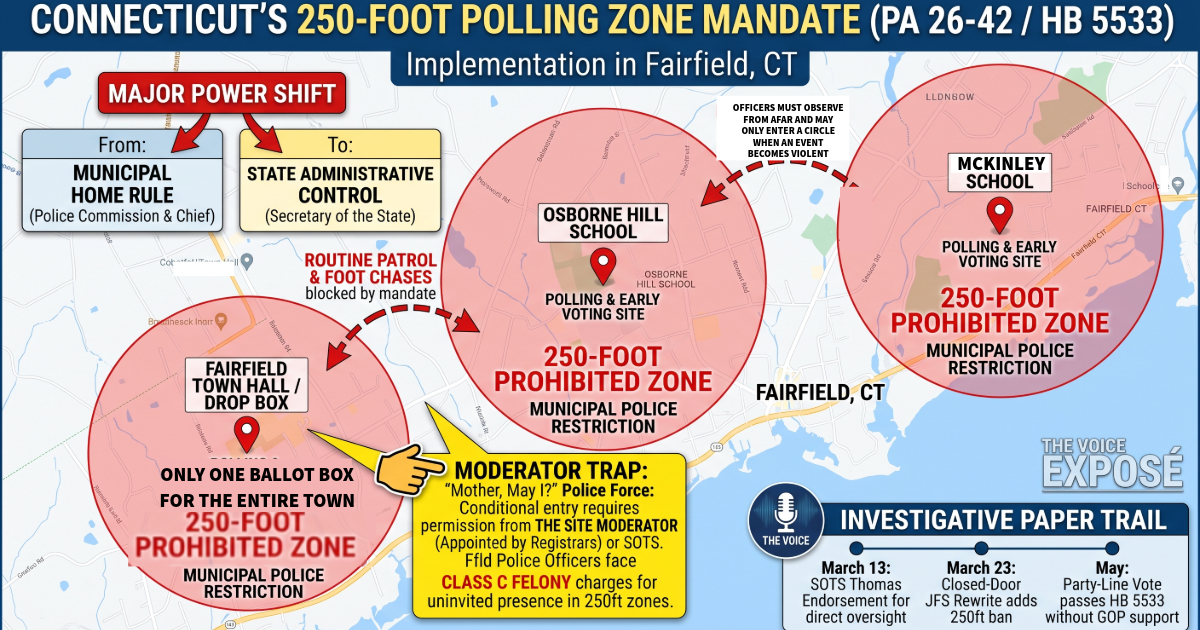
Picture a 250-foot circle around all polling locations and electoral drop boxes. Police must observe from the perimeter, and if they see a physical confrontation (more than a war of words), run the length of a football field to intercede. There are other strange provisions as well, like having to request access at least 24 hours in advance to the Secretary of the State (SOTS) and CT Attorney General (CTAG). If the authorities are going to take an enforcement action, for example arrest somebody, they have to alert both offices at least a day ahead with a judicial warrant. SOTS can designate local representatives to act in their stead at polling sites. It is in the books as a Class C felony with up to a 10-year jail sentence, making officers think about the ramifications vs. doing the right thing when in the field.
As for the ballots themselves, as police are not allowed on site, it raises questions on their chain of custody, especially in Fairfield where there is documentation of ballot malfeasance. What if ICE does show up to harass votes; or if someone – say a citizen with a bullhorn – takes a position at the front door? Anything could happen in any town in Connecticut, yet it has rendered itself defenseless.
As Election Day rapidly approaches, the disconnect between a legislative agenda and on-the-ground reality grows more acute. By compelling law enforcement to the periphery, the state has not only compromised public safety but has also reinforced the ongoing questions regarding its own integrity. It has also eroded trust in elected officials and unfairly shined an incriminating spotlight on local police. They must be able to do the job they have always done and that the public wants them to do.
This is the summation in the CT Special Report: New legislation establishes several new criminal penalties related to elections. Specifically, the act makes it a class C felony (punishable by 1 to 10 years in prison, up to a $10,000 fine, or both) for law enforcement to knowingly be within 250 feet of an elections site, with certain exceptions, or being within this perimeter to check voter qualifications. Those that violate these provisions must also be disenfranchised. Additionally, the act generally prohibits anyone from wearing a mask or covering within 250 feet of an elections [sic] site that obscures the person’s face, head, or identity, and makes a violation a class D felony (punishable by up to five years in prison, up to a $5,000 fine, or both). The act also (1) extends existing penalties and relief for harassing a specific set of election workers so that they also apply to harassing assistant municipal clerks; (2) penalizes sharing voting tabulators or tabulator parts with unauthorized third parties; and (3) criminalizes tampering with absentee ballot drop boxes and related ballots (PA 26-42, §§ 57-60, as amended by PA 26-76, § 36, both effective July 1, 2026).
Sources: Yankee Institute, Oops he did it again.