Last Updated on March 6, 2026 by Matthew Hallock
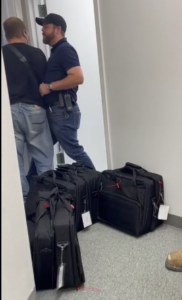
From 2024: Fairfield registrar “hip-checks” police officer during confrontation
The latest in an ongoing investigative series on election malfeasance in Connecticut.
FAIRFIELD, CT — As election officials present themselves with an award for their administration of the recent election, a comprehensive review of public records, video evidence, and formal complaints reveals an electoral process marred by law enforcement intervention, statistical anomalies, and overt hostility toward independent oversight.
This report, the latest in an ongoing investigative series by The Voice, details a systemic pattern of electoral manipulation stretching from local Fairfield districts to neighboring towns—especially Bridgeport—to the highest levels of Connecticut state government.
Background: In a 2024 article titled Oops! He Did It Again: Another SEEC Complaint Against Fairfield Registrar Matthew Waggner, The Yankee Institute chronicles Waggner’s “bizarre” actions in elections in security camera footage. These actions include initiating physical contact with police officers, threatening to lock himself in a closet with ballots, telling fellow registrars they had to file Freedom of Information Acts to see votes, defying the directives of the town’s legal counsel, and more. The town attorney wrote at the time, [if the situation is] “left unabated there is a serious concern that the untenable situation in the ROV [Registrar of Voters] office will compromise the integrity of the upcoming November election.” Disturbingly, the recent special election for First Selectman documents that this pattern of behavior does continue unabated, casting doubt on its integrity.
Police Standoffs: The dysfunction within the Fairfield Registrar’s office was the subject of an investigation by the State Elections Enforcement Commission (SEEC). Former Fairfield Town Attorney James Baldwin filed a formal complaint describing the Democratic Registrar’s office as a center of “dysfunction and chaos”. Video evidence submitted with the complaint captures Waggner defying the Secretary of State’s orders regarding the dual-lock storage of election tabulators. The footage shows Waggner attempting to seize the machines, locking a closet door, and actively “hip-checking” a police officer. When an officer asked if he intended to make the situation difficult, Waggner explicitly replied, “Yes, I am going to make this difficult”.
The complaint also highlights separate breaches in the chain of custody for absentee ballots. In one case, Waggner ordered unreadable absentee ballots from Mill Hill School returned to Town Hall, where he conducted unauthorized hand-counts without the legally required moderator’s supervision.
Nothing Has Changed: These practices provide critical context for the anomalies witnessed during the 2026 special election for First Selectman. On election night, the polls closed at 8:00 PM. By 9:00 PM, a press release was issued containing the final tabulations. The claim that thousands of paper ballots across ten different districts were securely processed, verified, counted, with final numbers released to the media and published in under one hour, defies the physical realities of election tabulation. Furthermore, instead of utilizing official state transparency portals, election data was funneled into a private domain, fairfieldvotes.org, which is operated by the same registrar in question, Waggner.
Multiple Voter Rolls and the Silencing of Candidates: The structural manipulation extends to the voter rolls themselves. Investigations into the registrar’s office revealed that the town utilizes multiple databases: purchasing “unclean” mailing lists from the post office for general outreach, while reserving accurate lists for the Democratic Town Committee. When presented with clear evidence that they were using multiple voter rolls, the questioning was shut down with the response “This conversation is over.”
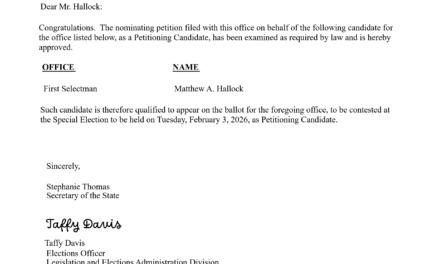
When The Voice publisher Matthew Hallock ran as an independent candidate to document this system from the inside, the municipal machinery actively suppressed his campaign. The registrar wrote and released to the media a bio without his knowledge, labeling him a “fence flag painter”. In the presence of other election officials, Waggner was argumentative with the candidate and co-workers in the room (“This conversation is over [puts on headphones]”); discriminatory (That’s what you get for being a minority party”), made threats (“Don’t mess with my [voting] districts”), provided wrong information (“You have to form a political party”) and more. Attempts to seek answers regarding discrepancies and the inequitable treatment of candidates were stonewalled. Abrupt, conversation-ending replies followed reminders that this was discrimination, that he was acting on behalf of the town, and that it was their obligation to let the voting public know the candidates were.
The “Commerce Drive” Pipeline to Hartford: The Fairfield electoral machinery does not operate in a vacuum; it acts as a feeder system for state-level control. An examination of Fairfield’s District 6—also known as the controversial Commerce Drive district—reveals a direct pipeline from local gerrymandering to the state Capitol.
Former RTM representatives from this specific Fairfield district have been elevated to top state positions: Rob Blanchard now serves as the Director of Communications for Governor Ned Lamont, and Jennifer Barahona was sworn in as the Deputy Secretary of the State. The very officials now overseeing state elections and public messaging come from the district that has been identified as the “mustard seed” for the overdevelopment issues plaguing towns across the state. As recently as this week, the state-sponsored CMDA changed zoning in District 6 to accommodate even more large-scale development and multifamily housing, despite the community’s strenuous objections.
Bridgeport is The Source of the Nile: Fairfield’s dysfunction mirrors the established template of neighboring Bridgeport, which serves as the hub for the state’s political machinery. The state’s tolerance for electoral malfeasance was recently highlighted during the 21st District State Senate special election, where a Republican Party convention was hosted at Testo’s Restaurant in Monroe—owned by Mario Testa, long considered the architect of Bridgeport’s political maneuvers and head of its Democratic Town Committee. The Voice filed an official complaint over Testa working at the same time with both political parties, but the SEEC denied it.
This bipartisan manipulation is protected by a toothless state regulatory system. During Joe Ganim’s 2018 run for governor, an audit revealed his campaign could not account for over $840,000 in contributions, producing no financial records. The SEEC left the investigation open for five years, waiting until Ganim filed to run for mayor again, before quietly closing the case with a token $2,000 fine and zero jail time.
The pattern of unchecked malfeasance continued into Ganim’s mayoral re-election. State authorities accepted the appointment of Coleen le Pere as campaign treasurer—an out-of-town individual utilizing a P.O. Box with a documented history of “catfishing” and financial exploitation of a woman she met online.
As Fairfield officials hand themselves an award, they celebrate an electoral system defined by police standoffs, altered voter rolls, and a deliberate pipeline of unaccountability that stretches from Bridgeport to the Governor’s office.